
Nottoway Projected and Actual Release
VADOC labels the public locator field Release Date. For a person who is still confined, that field is a calculation based on information available to the agency. “Projected release date” is a useful plain-language description, but it must not be changed into a claim that the person will walk out at a set hour. VADOC says its locator updates daily and warns that information can be inaccurate or old.
The actual release is the completed custody event. At PRJ, that means the person has passed release processing and left that jail’s custody. In VADOC, it may mean movement from prison to supervision or full discharge. A transfer to another institution or custodian is not community release.
A pretrial Nottoway detainee has no sentence-based date. A bond order, dismissal, or later sentence can create legal authority to leave, yet another case, detainer, appeal, or transfer can keep the person in custody. Confirm the physical exit through PRJ records or a Virginia Jail VINE event.
Find a Nottoway Release Date
Start with the custody system, not the address alone. Nottoway Correctional Center and Nottoway Work Center are VADOC facilities. Piedmont Regional Jail is a regional jail serving Nottoway arrests from Farmville. Each keeps a different record, and a PRJ booking number will not replace a seven-digit DOC ID.
- Identify the current custodian from PRJ, VADOC, the court file, or a VINE event. Treat a missing PRJ result only as a reason to investigate.
- For a state prisoner, open the VADOC Inmate and Supervisee Locator. Search by DOC ID, or use the required name fields and available filters.
- Open the matching result. Reconcile the name, age details, DOC ID, facility, status, and exact Release Date label.
- For a local sentence at PRJ, obtain the Nottoway sentencing order and ask PRJ Records for the authority that calculated time, credit applied, and actual release entry.
- For a fully inactive VADOC record, request the existing time-computation, release, or discharge record through the agency’s records process.
Namesakes and multiple cases cause errors. Use a case number, booking number, birth date, charge, and facility when available. A date must be tied to a specific custody episode. The complete Nottoway County released-inmate search path helps trace a person across PRJ, court, VADOC, federal, and immigration systems.
Note: Record the date and time of a locator check because both custody status and calculated dates may change after the search.
Nottoway Pretrial Release Dates
A person awaiting trial at PRJ does not have a VADOC sentence computation merely because the person is confined. Search the matching Nottoway court case for bond, remand, dismissal, trial, and sentencing entries. Remand means the court returned the person to custody. A bond order authorizes a path to release, but bond still must be satisfied and every other hold must clear.
Nottoway General District Court handles arraignments, bond matters, misdemeanors, and felony preliminary hearings. Its local schedule places bond and video arraignment matters with PRJ on Wednesdays. A felony can later move to Circuit Court for indictment, trial, and sentence. That sequence may require records from both courts before the legal basis for a projected or expected exit is clear.
The Nottoway Combined District Court page supplies the local docket and clerk route. The Nottoway Circuit Court page supplies the circuit clerk and certified-order route. After finding the order, ask PRJ Records whether the person actually left and at what time. Court authority and physical release should remain separate facts.
Note: A court order can explain why release should occur, but PRJ’s record confirms whether processing ended in an actual exit.
Nottoway VADOC Release Date Fields
The locator accepts either a DOC number or a name search. A DOC number is the strongest key. Without it, the interface requires the full last name and enough of the first name, then allows refinement through details such as location, race, sex, or age range. Those fields distinguish records; they do not create the release date.
| Field | How to read it | Limit |
|---|---|---|
| VADOC number | Seven-digit state identifier | Not a PRJ booking number |
| Location or status | May identify a prison or community corrections district | A district office means supervision, not confinement there |
| Release Date | VADOC’s exact public label for the computed date | Not a guaranteed exit time |
| Name and age details | Help confirm the correct person | Common names require more identifiers |
The official locator page shows the state search form used for Nottoway correctional records.
Open the official VADOC locator source.
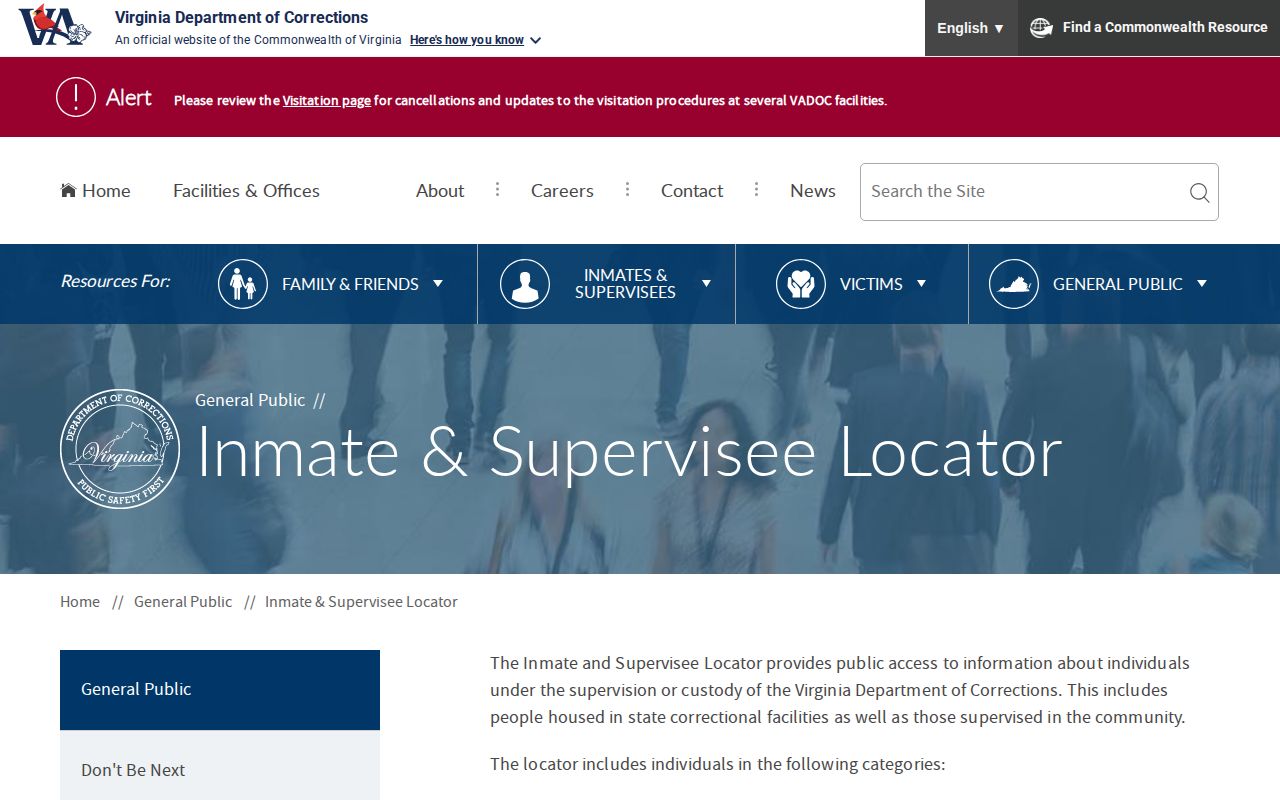
The captured form illustrates why a state DOC number and matching personal details are more reliable than a broad name-only search.
Nottoway Release Date Computation
The responsible authority depends on sentence type and active time. VADOC generally computes longer active state sentences. A local jail authority handles applicable local sentences. Inputs may include time in jail before VADOC intake, all active terms, whether terms run together or one after another, offense dates, the credit plan, classification, court corrections, and other holds.
Virginia Code § 53.1-187 governs qualifying credit for confinement before trial and conviction. A sentencing order supplies the legal term, but the order may not show the final arithmetic after all credits. Ask the calculating authority for the existing time-computation record rather than doing the math from a docket summary.
Concurrent terms run at the same time. Consecutive terms run one after the other. A detainer is a request or legal basis for another custodian to hold or receive the person. These details can keep a person confined beyond the date someone expects from one charge alone.
Offense dates are critical because Virginia’s credit rules changed across legal eras. The date of conviction is not always the date used to select a credit scheme. VADOC must apply the governing law to each active term, account for qualifying time already spent in jail, and resolve how several terms interact. A family calculation that uses just the sentence length and booking date can omit all of those controls.
Ask for the calculation’s inputs when a listed date seems wrong. Useful records include the final sentencing order, jail-credit entry, active-term summary, earned-credit class, and any corrected order received by the agency. The goal is to identify a specific record error or later change, not to demand that staff predict a gate time that has not occurred.
Note: A single Nottoway court case may not reveal another active sentence or hold that controls the final custody outcome.
Nottoway Earned Release Credits
Virginia separates Good Conduct Allowance from Earned Sentence Credits. VADOC describes Good Conduct Allowance as generally applying to felony offenses before 1995 and misdemeanor offenses before 2008. Its classifications can range from no allowance to thirty allowance days for each thirty served under the governing older-law provisions.
Earned Sentence Credits generally apply to felonies committed on or after January 1, 1995. Under the current version of § 53.1-202.2, one credit equals one day deducted. Section 53.1-202.3 sets two main structures. Listed serious or excluded offenses are capped at 4.5 days per thirty served, subject to the statute. Other eligible offenses may earn fifteen, 7.5, 3.5, or zero days per thirty according to class level.
Classification is reviewed at least once each year and can change after discipline or noncompliance. The statute also provides an appeal path. Credits cannot be reduced just because a program was unavailable, and they do not shorten the time needed to become parole eligible.
Why Nottoway Release Dates Change
A projected date is recalculated when an input changes. Some changes benefit the prisoner, while others extend the expected time. The public locator may show the new result only after the agency updates its system. That is why old screenshots and secondhand dates are weak proof.
| Factor | Possible effect | Best confirmation |
|---|---|---|
| Earned-credit class | More or fewer credits affect the calculation | VADOC time-computation record |
| Discipline or noncompliance | Classification or credits may change under the rules | Current agency computation |
| Corrected court order | Active term or sentence structure may change | Certified amended order and recalculation |
| Concurrent or consecutive terms | Terms overlap or extend the total time | Sentencing orders and computation |
| Detainer or other hold | Another agency may receive or keep custody | Holding and receiving custodians |
| Parole action | An eligible sentence may receive a Board decision | Board record plus later VADOC release event |
A Parole Board grant is not an immediate release. Current law directs VADOC to set the ordinary actual date no sooner than thirty business days after the chair’s notice, apart from a specified terminal-illness route. A Board PDF must therefore be paired with the later VADOC custody record.
Nottoway Jail Release Timing
For a Nottoway local sentence at Piedmont Regional Jail, ask which authority calculated the time and which jail credit was applied. The Nottoway sentencing order explains the legal sentence. PRJ’s release record establishes the physical custody event. Neither should be substituted for the other.
PRJ’s revised July 2026 policy says offender releases are not processed between 10:00 p.m. and 7:00 a.m., regardless of release reason. Legal eligibility that arrives overnight can precede the actual exit. The rule does not promise release at 7:00 a.m.; paperwork, identity checks, property processing, transport, and other holds can still affect timing. The official PRJ release-hours notice and its revised memorandum document this local rule, which should be rechecked before planning transport.
A VINE alert can provide timely notice of a local-jail event. For notification steps, use the Nottoway County VINELink check. Then confirm the exact event, facility, and release time with PRJ. For state-prison custody, use VADOC and its separate notification process instead.
If the PRJ event is a transfer, the receiving agency owns the next date. A move to VADOC can replace a local calculation with a state computation after intake and sentence review. A move to federal or immigration custody requires that system’s record. Do not keep applying the old PRJ estimate once another custodian has taken control.
Note: A computed calendar date and a jail gate timestamp answer different questions; preserve both when documenting a Nottoway release.