
Nottoway Parole and Probation Compared
Probation is a court-ordered status. It may take the place of a jail term, follow a suspended sentence, or begin after part of a term is served. Parole is conditional release from an eligible prison sentence after a decision by the Virginia Parole Board. Virginia ended discretionary parole for most felony offenses committed on or after January 1, 1995, so parole should never be assumed merely because a Nottoway County person left prison.
Post-release supervision is another exact term found in some Virginia orders. Mandatory release may also place a person in the community under conditions. VADOC Community Corrections carries out supervision, but the source of authority differs. Read the court order, Board action, and locator wording before describing the status.
| Feature | Probation | Parole |
|---|---|---|
| Who authorizes it | A Virginia court | Virginia Parole Board for an eligible sentence |
| When it may begin | Instead of confinement or after a custodial term | After part of an eligible prison sentence |
| Who supervises | VADOC Community Corrections | VADOC Community Corrections |
| Best source | Court order and VADOC locator | Board report, VADOC locator, and release record |
- Supervisee
- A person monitored in the community by VADOC.
- Absconder
- A person alleged to have stopped reporting or left supervision without approval. Confirm the status through an official record.
- Discharge
- The formal end of custody or supervision, not just release from a building.
- Revocation
- A legal action that may withdraw parole or probation after a violation finding.
Verify Nottoway Post-Release Supervision
The official VADOC Inmate and Supervisee Locator covers people in state custody and people assigned to community supervision. Search by the seven-digit DOC ID when it is known. Otherwise, enter at least the first three letters of the first name with the full last name. The live interface also offers location, race, sex, and age-range filters. Those details help separate people with similar names.
A district-office location usually points to community supervision, not confinement inside that office. VADOC says the locator is updated daily and warns that details may be inaccurate or old. A person who has fully discharged can fall out of the active locator, so an empty search is not a complete history.
- Gather the full name, date of birth, seven-digit DOC ID if known, and the Nottoway court case number.
- Search the VADOC locator and open the result whose identifiers match. Note the status, location, and exact Release Date label.
- Determine whether the source says probation, parole, post-release supervision, custody, or another status. Do not replace its wording with a guess.
- Check the Nottoway court case for a probation order, or review the Parole Board record when parole is claimed.
- Contact the displayed VADOC district for what it may lawfully confirm. Save the date and time of each check.
For a broader release chronology before the supervision check, use the Nottoway County released-inmate search and records path. It distinguishes a PRJ exit from transfer to state, federal, or immigration custody.
Note: A locator result reflects the state system at the time checked; it is not a certified order or complete inactive-record archive.
Nottoway Probation District Seven
Nottoway County is assigned to VADOC Probation and Parole District 7 in Petersburg. The district also serves Petersburg, Amelia, Dinwiddie, and Powhatan. That regional setup matters. A person released from a Nottoway case is not routed to a probation counter at the county courthouse simply because the case began there.
The VADOC facilities and offices directory is the source for the district assignment and current office details. Staffing can change, so confirm the directory before relying on a named employee. The captured directory view below shows the Nottoway correctional locations and District 7 context together.
6 Brasfield Parkway
Petersburg, VA 23805
(804) 524-6542
Serves Nottoway County
The official VADOC directory source is shown below.
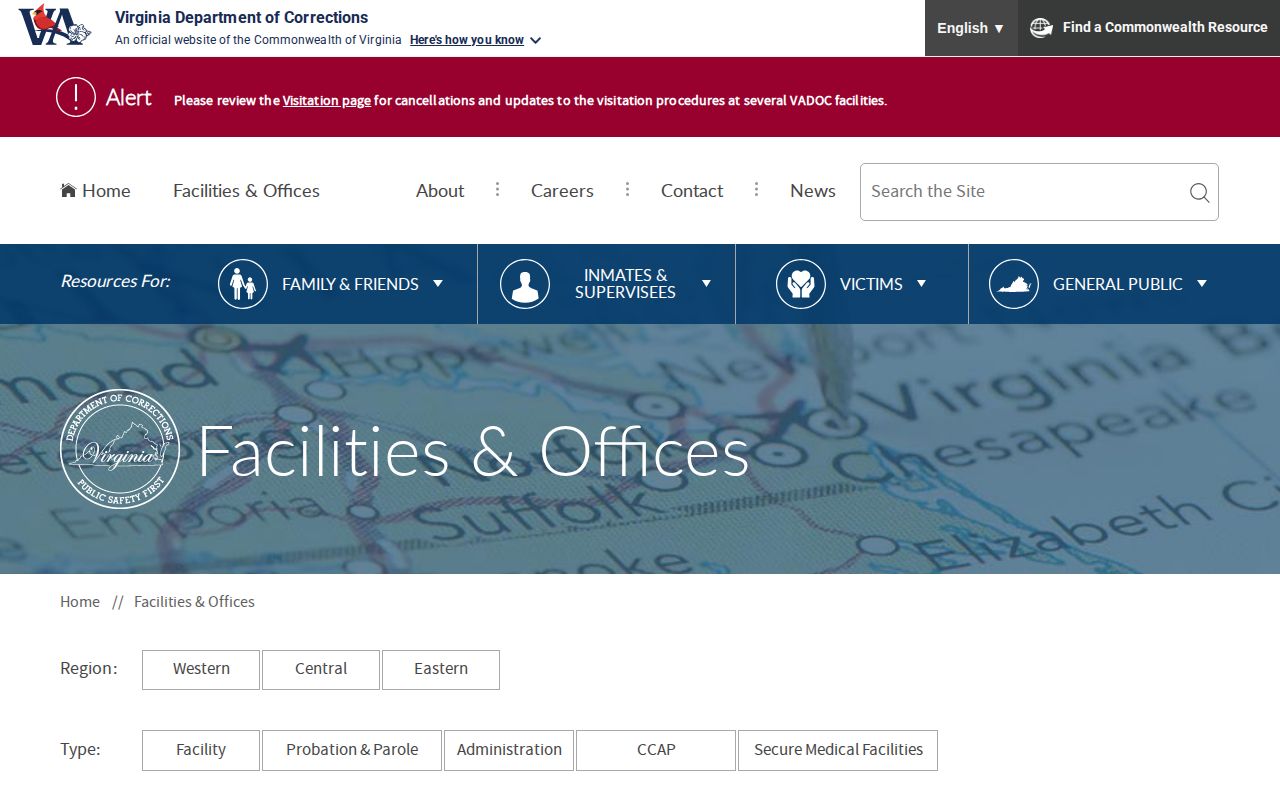
The image helps distinguish a community supervision office from Nottoway Correctional Center and Nottoway Work Center, which are custody facilities.
Nottoway Supervision Violations and Warrants
Conditions are individual. They may come from a court order, a Parole Board decision, or VADOC’s supervision plan. VADOC describes intensive, medium, and low levels, but a general level description does not prove one person’s report schedule. Only the supervising office and controlling record can confirm the terms that apply.
No official statewide public VADOC absconder list was found in the source sweep. A missed locator result, old address, or failure to answer a call does not prove absconder status. Check the Nottoway court docket for a warrant or violation proceeding and ask District 7 what it can disclose. If a warrant led to a new arrest, the person may return to PRJ or another custodian.
A violation allegation is not the same as a violation finding. Probation matters return to the sentencing court. Parole violation detention and revocation fall within the Board’s role. Quote the official status and date rather than turning a pending event into a final outcome.
Custody notification and supervision status answer separate questions. If an alleged violation causes detention at PRJ, the official current-custody lookup can show PRJ custody, while the Nottoway court docket may show the warrant or hearing. Neither source states the full supervision conditions. District 7, the sentencing court, and the Parole Board each speak only within their legal role.
Note: Virginia Jail VINE tracks local-jail custody events, not the full terms or final outcome of community supervision.
Nottoway Parole Decision Records
The Virginia Parole Board publishes public-meeting material and monthly decision reports. A docket is a review list, not proof that a hearing ended in release. A decision report can show grant or deny language and reasons, yet a grant still is not the physical release event.
Under the current version of Virginia Code § 53.1-136, an ordinary grant does not produce an immediate exit. VADOC sets the actual date no sooner than thirty business days after receiving the chair’s notice, apart from the specified terminal-illness route. Confirm the later custody change in VADOC records.
Eligibility is also narrow. Read § 53.1-151 with the parole-abolition law, the offense date, and any exception. The base fractions alone cannot calculate eligibility for every sentence. Juvenile-offense, old-law, geriatric, recidivist, and special statutory paths have distinct rules.
Since July 1, 2024, the Board meets by video with an offender when it is inclined to grant discretionary parole or geriatric conditional release. It posts an agenda at least three working days before that public meeting, then provides minutes. Dates are event-driven, not a fixed weekly schedule. Not every review becomes one of these meetings. Monthly Parole Reports are delayed until the end of the following month so required notifications can occur. Read the individualized action and reason, then check VADOC for the later release or supervision entry.
Nottoway Release Recovery Connection
The Virginia Opioid Abatement Authority’s 2025 annual report identifies a Piedmont Regional Jail Recovery Program with Prince Edward and Nottoway as partners. The report lists a $50,000 award. This is a specific regional reentry connection, not proof that every released Nottoway County person qualifies or that the program controls probation conditions.
The distinction protects accuracy. Treatment or recovery participation may support a return to the community, while legal supervision still comes from the court, Board, and VADOC. Program staff cannot be assumed to replace District 7, and program involvement should not be inferred from a person’s custody or supervision result.
For confirmed program scope, consult the official 2025 authority report and PRJ. Ask about current eligibility rather than relying on the award summary.
Note: A regional recovery award documents a local connection, but it does not promise enrollment, completion, release, or supervision discharge.
Nottoway Supervision Discharge Records
Supervision ends through a formal discharge or other lawful order, not because a name stops appearing online. Once both custody and supervision are inactive, the VADOC locator may no longer return the person. VADOC Operating Procedure 050.6 identifies Form 17, Request for Records for an Inactive Offender, as the records path.
A focused request should include the full name, seven-digit DOC ID, approximate dates, former facility or district, and the existing records sought. Useful items include a public commitment record, time computation, release or discharge entry, and supervision-discharge record. VADOC may withhold protected prison, parole, probation, medical, security, or personal material under Virginia law.
Form 14 is VADOC’s consent form when authorization is needed for a record. Consent does not turn every protected field into a public record, but it can help the agency process a request that depends on the former supervisee’s permission. Follow the current form instructions and send the request to the agency custodian, not to District 7 merely because that office once supervised the person.
Virginia FOIA gives access to existing public records. It does not require VADOC to create a new explanation. Ask for the record as kept, and request a court-certified order from the Nottoway clerk when the court ended probation. The request should distinguish prison release from supervision discharge. One entry may show when confinement ended, while another shows when all monitoring ended. Ask for both and preserve the agency’s original labels.